MURPHY OPOKU APPIAH
AUTHOR
Abstract
Focusing on the oversight functions of Parliament, this essay analyses the approval process of presidential nominees to high offices in Ghana. It critiques the current legal framework and suggests practical improvements to address identified challenges.
INTRODUCTION
The role of parliament in a democratic state transcends the making of laws. In actuality, parliament performs crucial functions including the task of ensuring that laws made are complied with and processes followed. This check is exercised on the remaining arms of government, namely, the executive and the judiciary. This is termed as the oversight function of parliament. Oversight is an offshoot of the concept of separation of powers and thus, seeks to prevent the abuse of power by the executive and judiciary in accordance with law.
Although the president is the appointing authority under Ghana’s 1992 Constitution, parliament plays a critical role by approving or rejecting persons nominated to hold political and judicial offices. This article shall examine this role in its entirety, identifying and scrutinizing the exercise of this power by parliament, with the balance of law and an eye for reform.
The Conceptualization of Separation of Powers in Ghana’s Democracy.
Separation of powers is a political doctrine which provides that power should not be concentrated at any point in the political sphere. Essentially, the doctrine prescribes what the structure of government ought to be for the attainment of certain desirable ends. Accordingly, the various arms of government, namely the executive, legislature and judiciary should be distinct in terms of powers, functions and personnel. The legislature is to make laws, judiciary to interpret the laws, and the executive to perform executory functions. However, the doctrine accommodates checks and balances on the various arms of government as its ultimate rationale is to prevent the concentration of power and arbitrary rule. The doctrine is traced to Aristotle but was conceptualized by Baron De Montesquieu in his book, ‘ The Spirit of The Laws’, 1748.
Baron espoused that the best form of government is one which exercises a balance of power amongst the various arms of government. Thus, each arm of government holds distinct powers, that is; the legislature makes laws, the executive enforces the laws, and the Judiciary interpret the laws made. This does not only provide serenity in governance, but also helps to promote efficiency since various arms of government can focus on specific task and provide maximum outputs.
In Ghana’s democracy, the doctrine of separation of powers has been conceptualized under two main headings. First, separation of powers in its purest form, that is, a distinctive separation of the various organs of government in terms of powers. This speaks to the exclusivity of certain powers designated to a specified arm of government.
Undoubtedly, executive power is vest in the executive, legislative powers in the legislature and judicial power in the courts.[1] The President, who heads the executive branch is the custodian of executive power in Ghana and such power is exercised by his subordinates under his authority.[2] Therefore, it is generally presumed that the actions of ministers, deputy ministers, MCEs and DCEs are the acts of the President and are directly attributable to him.
The legislative power of the state is exercised by Parliament in accordance with the Constitution. Members of parliament together with the leadership of parliament which includes the speaker of parliament, deputy speakers, clerks and leaders of the majority and minority group in parliament, are tasked with this all-important role of law making.[3]
The judicial power of the state is held by the judiciary which is responsible for interpreting laws and adjudication.[4] Although each arm of government is separate and distinct, powers, functions, and personnel overlap to ensure that power ascribed to any arm of government is not exercised in isolation.
This is the concept of checks and balances which prominently featured in Ghana’s constitution. Articles 78 and 79 of the 1992 Constitution of Ghana provides to the effect that the president’s power to appoint ministers and deputy ministers is subject to the approval of parliament. Consequently, parliament may legally reject the appointment of a nominee minister or deputy minister. On the other hand, the law-making powers of Parliament are checked by the executive through assenting to bills,[5] a power reserved for the President. Consequently, the President may refuse to assent to a bill and provide in a memorandum addressed to the speaker, reasons same.
The judiciary also exercises the power of judicial review over laws made by Parliament, Executive actions and Instrument. If any of these is found to be inconsistent with the Constitution, it shall be declared void and of no effect.[6]
Parliament also exercises checks on the courts through the approval of appointees which will be extensively discussed. The Executive branch also exercises checks on the judiciary through the exercise of the prerogative of mercy by the President.[7]
The second conceptualization is the creation of a hybrid system of separation of powers under Article 78 of the 1992 Constitution of Ghana.[8] Here, majority of ministers appointed by the President must be Parliamentarians. This signifies a fusion of the functions and personnel of the executive branch with parliament. Thus, there is a heavy presence of the executive branch in the law-making organ.
That notwithstanding, parliament performs oversight functions on both the executive and the judiciary. One of such important oversight functions performed by parliament is the vetting of political nominees or appointees by the appointing authority. In Ghana the president is empowered to making appointments. The appointment of judges, ministers of states, deputy ministers, CEOs of various statistical corporations and other appointees to crucial offices such as the Inspector General of Police Are made by the President of the Republic subject to the prior Approval of Parliament.
The Concept of Oversight.
Oversight refers to the power of parliament to scrutinize government and ensure that the implementation power of government is exercised in accordance with laws made. This concept has evolved over the years, with its earliest trace to ancient Greece. In ancient Greece, the legislative assembly also known as the Ecclesia, took a keen interest in how the laws made were implemented by those who held executive power. As a theory, Baron De Montesquieu postulated oversight to the conclusion that whereas all arms of government are separate, the legislature is free to scrutinize how the executive implements the laws of the state.
Thus, although the legislature’s primary role is to make laws, parliament also performs the necessary task of ensuring executive functions are performed lawfully. As succinctly put by John Stuart Mill;
“The proper office of a representative is to watch and control the government: to throw the light of publicity on its acts; to compel a full exposition and justification on all of them which anyone considers questionable; to censure them if found condemnable, and, if the men who compose the government abuse their trust, or fulfill it in a manner which conflicts the deliberate sense of the nation, to expel them from office.”[9]
Thus, oversight is a cornerstone to ensuring the proper practice of accountable governance and promoting democratic principles in any given state.
In Ghana, parliament exercises enormous oversight on the executive arm. Through debates,[10] resolution to remove the President,[11] parliamentary hearings[12], budget oversight[13], vote of censure on a minister of state[14] amongst others, parliament exerts its power to ensure government remains compliant with laws made. However, the practice of a hybrid of the Westminster and strict American system Separation of powers presents the challenge of an executive encroachment in parliamentary circles which may inhibit the exercise of such oversight functions.
That notwithstanding, parliament is mandated to set up standing committees which shall perform such functions including investigating and inquiring into the activities and administration of ministries and departments as parliament may determine.[15] Importantly, parliament grants approval or rejects persons nominated by the President to the offices including minister of state[16], deputy minister[17], chief justice[18], and Justice of the Supreme Court[19].
Appointees Requiring Parliamentary Scrutiny.
Under the 1992 Constitution of Ghana, the President is vest with the power to make appointments to specific offices. These appointments include appointees to the office of Chief Justice,[20] Justices of the Superior Court of Judicature,[21] Ministers of State,[22] Deputy Ministers of State,[23] Regional Ministers and Deputies,[24] Electoral Commissioners,[25] Commissioner for Human Rights and Administrative Justice and his Deputies,[26] the Auditor-General,[27] the District Assemblies Common Fund Administrator,[28] Ambassadors and High Commissioners,[29] the Inspector-General of Police,[30] Director-General of the Prisons Service,[31] Chief of Defense Staff,[32] Service Chiefs,[33] District Chief Executives,[34] Chairmen and members of the Public Services Commission,[35] the Lands Commission, the Governing Board of Public Corporations,[36] the National Council for Higher Education[37] and Public officers which he may delegate to Governing Council.[38] The President’s power to appoint is not without scrutiny. Parliament plays a vital role in ensuring that the appointees of the President are fit for purpose. The President may also appoint a replacement to the office of Vice-President.[39]
The council of state plays a role as well. The role of the Council of State is two-fold. First, the President acts in consultation with the Council of State. This means the President must consult and receive the views of the Council on an appointee but this view or advice is not binding on him. Officers appointed by this procedure include Commissioner for Human Rights and Administrative Justice and the Auditor-General. The President also follows this process to appoint the District Assemblies Common Fund Administrator and the heads of the Police, Prisons, and Armed Forces.
Secondly, the President acts on the advice of the Council of State. In these cases, the President is generally expected to follow the specific recommendation given by the Council. This procedure is used for appointing the Chairman and members of the Electoral Commission by requiring the President to follow the advice of a separate body.
Judicial appointments to the Court of Appeal and High Court also require a separate process. The President appoints Justices of the Court of Appeal and the High Court by acting on the advice of the Judicial Council.[40] Thus, the president receives recommendations from the legal governing body.
Also, appointments are made by the President acting with various governing boards or local groups. The President appoints District Chief Executives with the approval of not less than two-thirds majority members of the assembly present and voting.[41] For the wider public service, the President often acts on the advice of the governing council of the corporation or service.
Parliament exercises its oversight powers on certain appointments made by the President. Through prior approval and approval of appointees to various positions, parliament ensures that those who are nominated to occupy such offices are examined, scrutinized and qualified to hold same. The president must obtain the prior approval of parliament for persons nominated to lead a ministry, or to serve as a regional minister. This requirement also applies to deputy ministers and deputy regional ministers.
If a vacancy occurs in the office of the vice-president, the president must nominate a new Vice-President who needs to be approved by parliament before he takes the oath of office.[42] Also, the president appoints the chief justice with the approval of the members of parliament.[43] Justices of the supreme court require also require the approval of parliament.[44] Importantly, the special prosecutor, though nominated by the attorney-general and appointed by the president, is required by law to receive the approval of parliament.[45]
Parliamentary approval is worded in two different ways under the 1992 Constitution. There is prior approval and approval of parliament simpliciter. Prior approval is the procedure for oversight of appointees including appointment as minister, deputy minister, regional minister and a deputy regional minister. On the other hand, appointments to the office of Chief Justice, a Justice of the Supreme Court, and a replacement to the office of Vice-President, require the approval of parliament.
On the face of it, it may be implied that a subtle distinction has been made by the use of the word prior.
Prior approval may connote a sequence of events where parliamentary approval or rejection must be given immediately after an appointee is named. On the other hand, approval of parliament may suggest a broader sense of conferring validity to an appointment made by the President and must not necessarily be done immediately after the appointee is named. This means appointments requiring approval of parliament are voidable or ‘semi-binding’ until parliament rejects or approves the nominee.
Thus, the appointee may act in a limited capacity such as taking on administrative roles akin to the office he has been appointed to. This may include office arrangements, getting to know staff, and public relations activities such as engagements with the media.
Qualifications of Appointees Requiring Parliamentary Approval.
The 1992 Constitution is explicit on the qualification for appointment to offices that require Parliament’s approval. For an individual to qualify for appointment as a minister of state or a deputy minister, he must meet the requirements set out in Article 94 of the 1992 Constitution[46] as they apply to him.
The nominee must be member of parliament[47] or be qualified to be one.[48] Thus, he must be a citizen of Ghana and must have reached the age of twenty-one. He is also required to be a registered voter and must have fulfilled all his tax obligations or made proper arrangements to pay them.[49]
Ministers of State form an integral part of the government as executive power is exercised through them, for and on behalf of the President. Therefore, a person cannot be appointed as a minister of state if he owes allegiance to another country or has been declared bankrupt without being discharged. The constitution also bars anyone who has been convicted of high treason, fraud, or offences involving state security from becoming ministers of state.[50]
Furthermore, if a commission of inquiry has found a person incompetent to hold public office or found that he misused state assets, that person is ineligible for appointment unless a period of ten years has passed or he has received a pardon.[51]
A person nominated for the office of chief justice or a justice of the supreme court must be of high moral character and proven integrity. Beyond their reputation, they must have a minimum of fifteen years of standing as a lawyer.[52]
A new vice-president must be appointed with the approval of parliament under Article 60 of the 1992 Constitution.[53] The person must meet the same qualifications as a presidential candidate. This requires the appointee to be a citizen of Ghana by birth and to have reached the age of forty. He must also be qualified to be elected as a member of parliament.
Parliamentary Approval.
The 1996 Presidential and Parliamentary general elections saw the election of His Excellency the President, Jerry John Rawlings to a second term of office. On his assumption to power for the second time, it was announced that the president had decided to retain some of his ministers of state. The president stated that since such ministers had already been approved by the previous parliament under the 4th Republic, they would not be presented to the new parliament for approval. The minority in parliament opposed this decision. They argued that under the 1992 constitution, a person could not act or be appointed as a minister without prior approval of parliament. Further, the Minority contended that the tenure of office of previous ministers ended on the dissolution of the previous parliament.
Despite these concerns, the decision of the president not reversed. The minister of finance, Kwame Peprah, one of the retained ministers was scheduled to present the budget to parliament on 7th December, 1997. The minority leader in parliament, J.H Mensah brought an action in the supreme court.
The Minority leader of parliament, J.H Mensah brought an action at the supreme court for a declaration that on a true and proper interpretation of articles 78(1), 79(1), 66(1), 11(1), and 11(3) of the constitution, no person can act as minister or deputy minister after 6th January 1997 without prior approval of the 2nd parliament of his appointment.[54] The Attorney-General raised a preliminary objection to action on the grounds that there was no defendant to the suit as the Attorney-General was also a retained minister and that the action was moot because the president had retracted its position by submitting the names of the retained ministers for prior approval.
The court had to, inter alia, resolve the following issues;
- Whether holdover ministers required a new round of parliamentary approval upon the commencement of a new presidential term.
- Whether or not a necessary incident of prior approval is the consideration and vetting of each nominee for ministerial appointment.
Issue one was resolved in the affirmative. The supreme court held that the prior approval of the second parliament was required. The court reasoned that the term of office of ministers was coterminous with that of the president and parliament. Consequently, the tenure of office of ministers and deputy ministers is 4 years. In events where the president gets a second term and wants to retain them, the president shall do so with the prior approval of parliament pursuant to articles 78(1) and 79(1).
Regarding the issue of whether vetting is a necessary incident of prior approval, the court held that the term “prior approval” is not a term of art with a fixed technical meaning like “vetting” or “screening”. The justices reasoned that the term appears in various sections of the Constitution where a mandatory public vetting process would be impractical or was clearly not intended by the framers. Instead, the court interpreted the expression in its ordinary sense to mean obtaining the formal consent of Parliament.
Thus, while Parliament must grant its approval, the specific method or procedure used to arrive at that decision is an internal matter for the legislature. Under Article 110(1) of the Constitution, Parliament has the autonomy to regulate its own proceedings through standing orders. Consequently, the court concluded that it cannot dictate to Parliament exactly how to conduct its approval process or mandate that every nominee must undergo a formal vetting committee hearing, as long as a valid form of consent is eventually given by Parliament.
This ruling is particularly relevant to the extent that it reveals the process of vetting is not synonymous to parliamentary approval. In fact, vetting is only a step in the process of receiving parliamentary approval and may be entirely absent or replaced by another method instituted by parliament if need be. Thus, in accordance with Article 110(1), Acquah JSC stated as follows;
‘In my view, the above provision empowers Parliament by standing orders to regulate its own procedure provided same does not infringe a provision of the Constitution, 1992.Thus the courts cannot intervene at the suit of a person who desires a different procedure, if the one he objects to is equally constitutional. For it is not the province of the court under articles 2 and 130(1) of the Constitution, 1992 to direct Parliament or the executive on how to conduct its proceedings or perform its business if the procedure or action adopted infringes no provision of the Constitution, 1992.’
The aftermath of this ruling has seen a deliberate incorporation of a precise procedure for parliamentary approval of public appointments. The Appointments Committee has been empowered to consider appointees and recommend them for approval or otherwise by vote or consensus.
Procedure in Standing Orders.
The New Standing Orders of Parliament designates the Appointments Committee with the responsibility of considering persons nominated by the President to hold offices including Chief Justice, Justice of the Supreme Court, Minister of State, Deputy Minister of State, Administrator of District Assemblies’ Common Fund, the Special Prosecutor and other persons specified under the Constitution or any enactment.[55]
The Committee consist of a Chairperson, a Ranking Member and the following Ex-officio members; first deputy speaker, deputy majority leader, minority leader, deputy minority leader, majority chief whip, minority chief whip, and two other members, one from the majority caucus and the other from the minority caucus. In addition, the leadership and two other members of the relevant subject matter, standing or select committee, shall join the ex-officio members of the committee to consider the nominee. These members shall exercise the same rights as ex-officio members.
A member of the Appointments Committee shall not be a minister, deputy minister, minister designate, or deputy minister designate, except where the minister for parliamentary affairs is the majority leader. Where a member of the Appointments Committee is nominated as a minister or deputy minister, the member shall cease to be a member of the Appointments Committee and be replaced by a member nominated by the leadership of the political party caucus that member belongs.
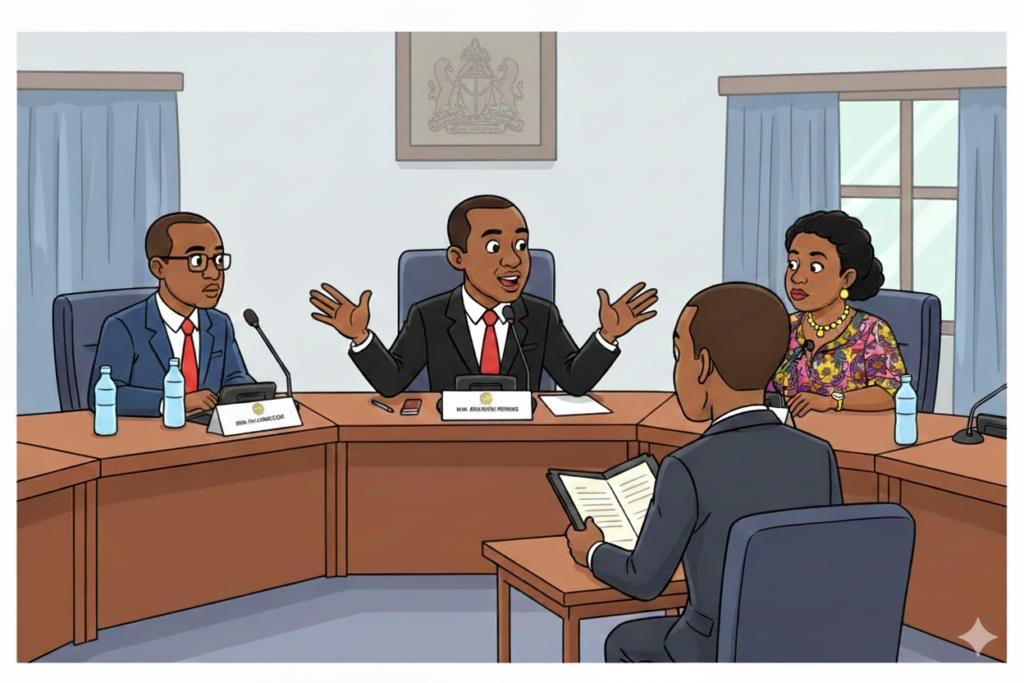
The first procedure outlined in the Standing Orders is public engagement and empanelment. The names of persons nominated by the President for specified offices is published in national newspapers to inform the public of the pending consideration, request memoranda, and accept representation from the general public. Here, the general public is not only informed of the pending approval of the nominee, but is also invited to participate in the process by contributing via memoranda or being present.
Consideration is the next procedure. Members of the Appointments Committee participate in the process of considering the persons nominated by the President. There is no concise definition of what constitutes consideration. Although long standing practice has indicated that parliament reverts to vetting nominees and airs same on national television, there is still room for exploring other means of considering persons nominated for office.
Within three days after the consideration of a nominee, the Appointments Committee shall recommend to parliament the reject or otherwise of the said nominee. The recommendation for approval or otherwise shall be either by vote or consensus.
Analysis of the Current Procedure.
The process of parliamentary approval for public appointees serves as a vital mechanism for ensuring legislative oversight and maintaining a system of checks and balances between the executive and the legislature. By requiring the president to obtain the approval of parliament before appointments are made, the 1992 constitution ensures that the exercise of executive power is subject to public scrutiny.
Obviously, this requirement prevents the president from having unchallenged power over the process of appointment and the subsequent running of the state. This is in line with the principle of checks and balances and the principal function of parliament to oversee the other arms of government.
The current framework under the 1992 Constitution and the procedure outlined in the New Standing Orders ensures that there is a degree probity and accountability in making public appointments. Parliament assesses the suitability, competence, and integrity of each nominee for public office. The general public is also permitted to participate in this process by submitting memoranda and petitions, ensuring that persons nominated are adequately scrutinized.
This process also reinforces the legitimacy of the government and its officials. Through a bipartisan review of appointees by parliament, a confirmation of an appointee conveys a national approval of the appointee. This process helps to build public trust in the administration of the country, as citizens can see that their representatives have thoroughly questioned the vision and qualifications of these appointees. This, to some extent, connotes support and acceptance of the persons playing critical roles in government.
Some shortfalls are however eminent in the current regime. The Appointments Committee is given a maximum of three days within which to report to parliament on whether an appointee should be approved or rejected.[56] This denotes an eminent assumption that the consideration process will ultimately lead to the approval of a nominee and therefore, much weigh, depth and finding should not be assigned to it. A three days window to present a report on a person designated to hold high offices such as Chief Justice, Minister of State or Justice of the Supreme Court is highly inadequate.
Another shortfall is that the rules do not provide for exceptional circumstances such as a hang parliament where parliament is unable to build consensus or call for a vote to approve or reject a nominee. In such situations, the fate of the nominee will be unknown.
There is also the critical issue of familiarity and perceived nepotism that may cloud this process. This is heavily attributed to the constitutional requirement under Article 78 to the effect that majority of ministers must be appointed from amongst members of parliament. This creates the problem of Parliamentarians vetting Parliamentarians. It may appear that the vigor, diligence and objectivity required to thoroughly scrutinize appointees will be lost. Friends may be more lenient or project a false sense aggression. Enemies may be too voracious, and neutrals may be inclined to do the bidding of their caucus.
Importantly, there is inadequate time to probe and investigate nominees. There is a heavy reliance on information submitted by the general public rather than commissioned investigations into the conduct, character and suitability of office of nominees.
Recommendations.
Parliamentary approval is a crucial segment of oversight and must be performed in a manner that maximizes probity, scrutiny, and accountability to the people of Ghana. Consequently, parliament’s consent must be given after an exhaustive process of scrutiny, exploring both internal and external mechanisms to provide Ghanaians with the best crop of leaders to administer governance. Thus, the process of parliamentary approval must be refined through the purging of identified issues and reform to ensure no blanket approval or rejection is handed blindly. The following measures may be put in place to resolve the issues identified.
First, the three-day timeframe designated to Appointments Committee to report to parliament for the appointment or rejection of nominees should be extended to fourteen days.[57] This would give the Appointments Committee enough time to access the suitability of a nominee to a specified office. The committee would be able to corroborate information, verify sources and furnish parliament with a concise and elaborate report to parliament that will justify the rejection or approval proposed.
There is also the question of what happens to a nominee if parliament is unable to confirm his or her status. These situations may arise in parliaments with many factions divided along party lines. Where there is no clear majority in parliament, opposing factions may disrupt parliament business by walking out of parliament or protesting. In such circumstances, a vote to confer parliamentary approval on a nominee will be impossible. Therefore, anticipatory rules must be put in place to cure this mischief. One solution to this problem is to espouse that a nominee is deemed to have been duly approved by parliament 21 days after Consideration.[58] This will bring opposition factions to the table and ensure that a vote is cast or consensus built to secure the rejection or approval of a nominee.
Third, it is of national significance that the Constitutional Review Committee Report recommends that parliament should be decoupled from the executive branch. The Report proposes an amendment of Article 78 of the 1992 Constitution:
“The Committee recommends an amendment to Article 78(1) to provide that no member of Parliament may be appointed a Minister of State or a Deputy Minister or Regional Minister. The Committee further recommends, as a companion amendment, that a member of Parliament who resigns from Parliament shall not be eligible for appointment as a Minister of State or a Deputy Minister or Regional Minister. The ineligibility for appointment shall however be limited to the term of Parliament which he or she was elected only.”
This a step in the right direction. It is critical to ensure that the all-important role of oversight played by parliament is exercised without fear or favor. Decoupling parliament from the executive will embolden and strengthen parliament to scrutinize nominees with little lobby and interference from the executive. This will ultimately establish an independent enquiry system which is much need to provide Ghanaians with suitable appointees to lead these vital offices.
Finally, it is suggested that investigative institutions such as the Bureau of National Investigation (BNI), Economic and Organized Crime Office (EOCO) and other the likes should be empowered and assigned to conduct thorough investigations into persons nominated for office and furnish same to parliament.[59] This will provide parliament with adequate information into the background of appointees and assist parliament in the performance of their duty.
CONCLUSION.
Parliamentary approval of persons nominated by the President to hold high offices is essential to promoting sustainable and good governance. The current framework for conferring parliamentary approval however good, can be improved through reforms such as decoupling Parliament from the Executive branch, empowering investigative institutions to conduct checks on nominees to prevent the worst from rising to power, increasing the time designated for reporting to parliament on the suitability or otherwise of nominees for office, and making rules in cater for extreme circumstances where Parliament has neither approved nor rejected a nomination of a candidate. These recommendations will aide Parliament better exercise its oversight role over parliament.
[1] Constitutional and Administrative Law (11th ed) edited by A W Bradley and K Ewing 1993 ELBS with Longman Croup Ltd, London, at page 7.
[2] Article 58(3) of the 1992 Constitution of Ghana.
[3] 1992 Constitution, art 93(2).
[4] Ibid, art 125(3).
[5] Ibid, 106(10).
[6] Ibid, art 2.
[7] Ibid, art 72.
[8] Ibid, art 78.
[9] Dennis Frank Thompson, ‘John Stuart Mill and Representative Government’ [2015] Princeton, Princeton University Press.
[10] Ibid, art 115.
[11] Ibid, art 69(11).
[12] Ibid, art 112.
[13] Ibid, art 179.
[14] Ibid 82(1).
[15] Ibid, art 103(3).
[16] Ibid, art 78(1).
[17] Ibid art 79.
[18] Ibid art 144(1).
[19] Ibid art 144(2).
[20] Ibid, art 144(1).
[21] Ibid art 142.
[22] Ibid art 78.
[23] Ibid.
[24] Ibid art 256.
[25] Ibid art 70(2)
[26] Ibid art 70(1)(a).
[27] Ibid art 70(1)(b).
[28] Ibid art 70(1)(c).
[29] Ibid art 74(1).
[30] Ibid art 202(1).
[31] Ibid art 207(1).
[32] Ibid art 212(1)(a).
[33] Ibid.
[34] Ibid art 243(1).
[35] Ibid art 70(1)(d).
[36] Ibid.
[37] Ibid.
[38] Ibid art 195(1).
[39] Ibid art 60(10).
[40] Ibid art 144(3).
[41] Ibid art 243
[42] Ibid.
[43] Ibid.
[44] Ibid.
[45] Section 13(3) of the Office of the Special Prosecutor Act, 2017.
[46] Ibid art 94.
[47] Ibid.
[48] Ibid art 78.
[49] Ibid.
[50] Ibid.
[51] Ibid.
[52] Ibid art 144.
[53] Ibid.
[54] Mensah v Attorney-General [1997-98] 1 GLR 227.
[55] Order 217 of the Standing Orders of Parliament, 2023.
[56] Ibid
[57] This is quite similar to the practice in Kenya. Section 8(1) of the Public Appointments (Parliamentary Approval) Act provides that a committee shall consider a nomination and table its report in the relevant house for debate and decision within fourteen days from the date on which the notification of nomination was given. The difference here is that the fourteen days start after nominee’s consideration by the Appointments Committee and not notification of Parliament of the nomination of such persons.
[58] Section 9 of the Public Appointments (Parliamentary Approval) Act, Kenya provides that if, after expiry of the period for consideration specified in section 8, Parliament has neither approved nor rejected a nomination of a candidate, the candidate shall be deemed to have been approved.
[59] In the United States, nominees for the cabinet and the federal judiciary undergo exhaustive background checks conducted by the Federal Bureau of Investigation (FBI) and are required to file detailed financial disclosures with the Office of Government Ethics. These investigations focus on character, conduct, and potential conflicts of interest, and the results are shared with the relevant Senate committee.
PARLIAMENTARY APPROVAL IN GHANADownload